Jul. 3rd, 2026 - Special Edition for America's 250 |
This week, we are taking a brief departure from our regular weekly update to mark a significant milestone being celebrated this weekend: the 250th anniversary of the signing of the Declaration of Independence, marking the birth of the United States of America.
Alongside this milestone, this year also marks 78 years of the economic relationship between the United States and Israel—a relationship that has undergone a profound transformation. What began as a framework rooted primarily in aid and support to the nascent state of Israel, has evolved into a deep strategic partnership, built on investment, innovation, and a high degree of economic integration between the two economies.
In this special edition, we highlight key aspects of this economic relationship.
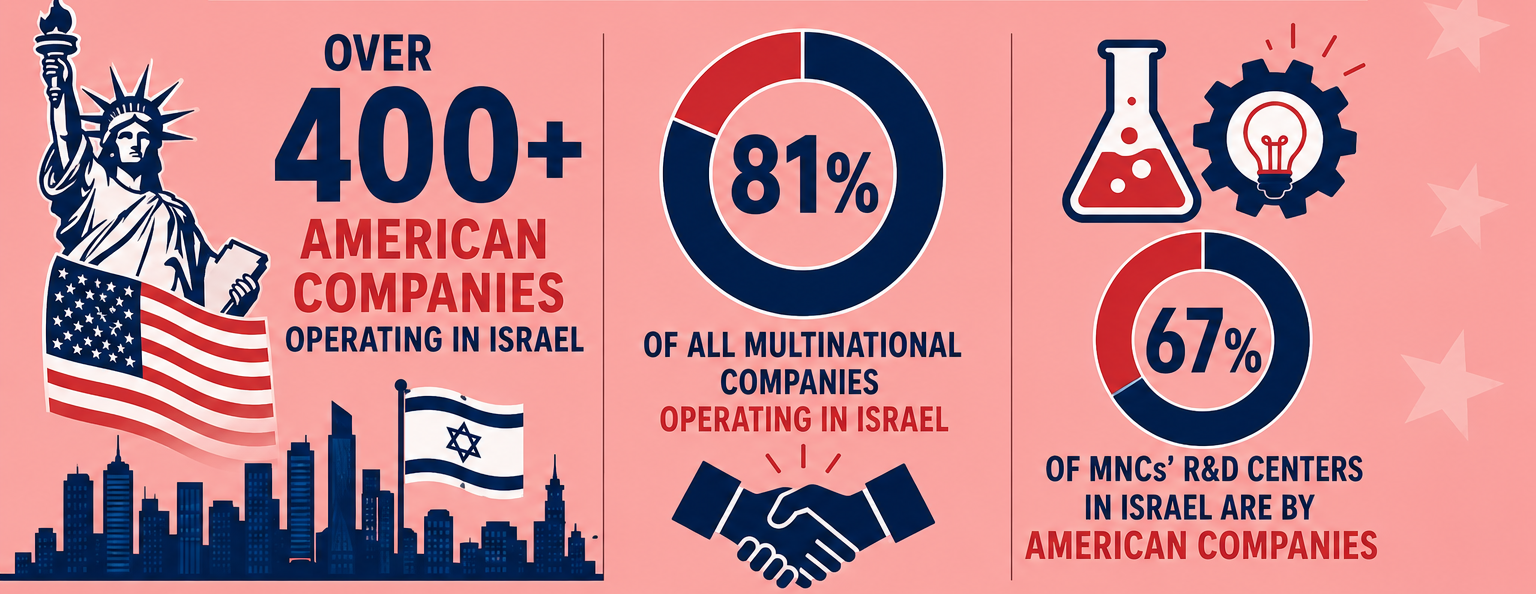
The United States was the first country to recognize Israel in 1948 and has since become its leading economic partner. The U.S.–Israel Free Trade Agreement, signed in 1985—the first such agreement for the United States—marked a turning point toward meaningful economic integration. Since then, the relationship has expanded significantly, encompassing substantial bilateral trade of $55b annually, two-way investment of $27b annually, extensive activity by over 400 American companies operating in Israel, and a strong presence of Israeli firms across the U.S. market.
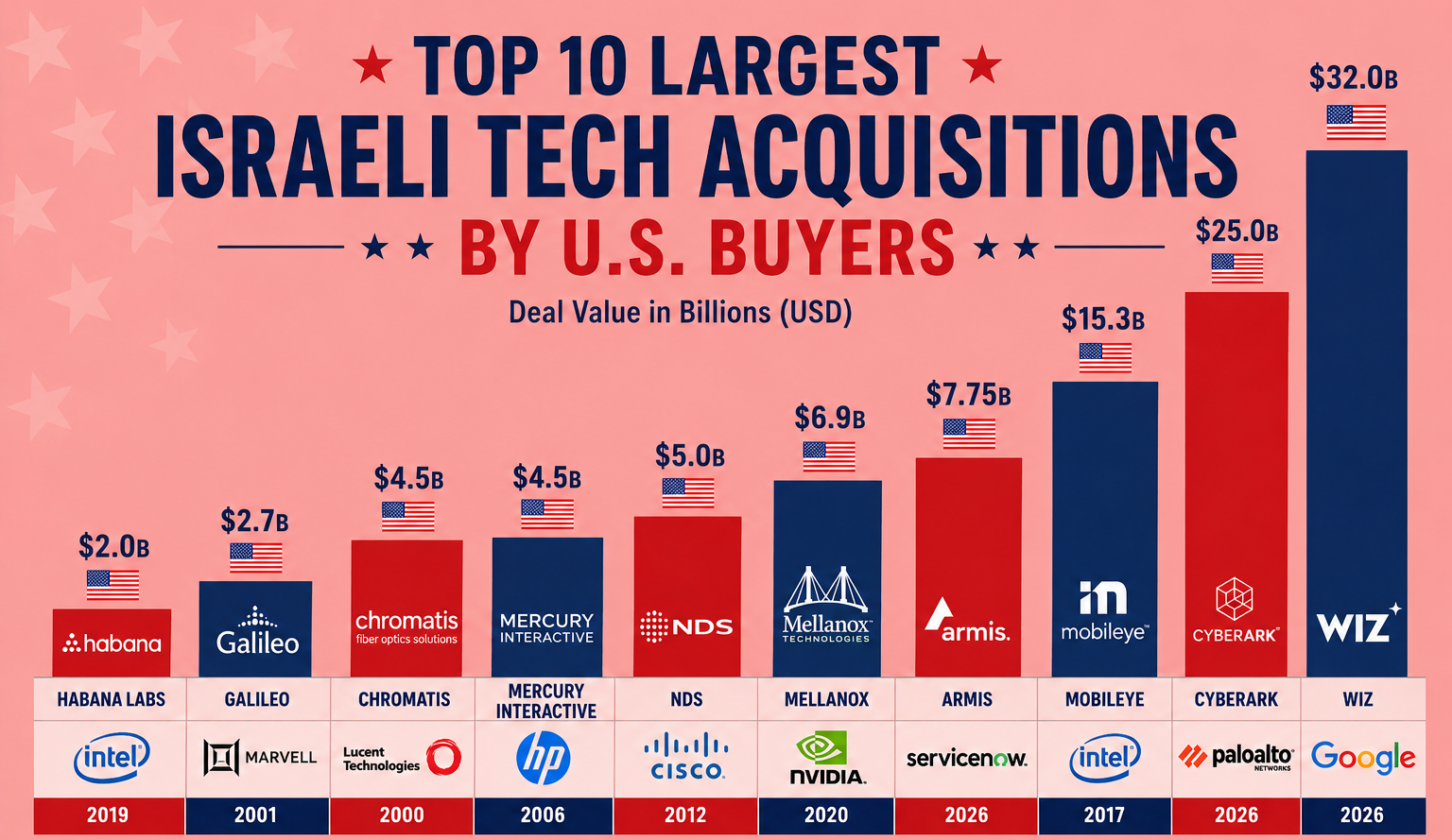
Over time, the economic relationship has shifted from a one-directional model of support to a two-way, mutually beneficial strategic partnership. Israel contributes to the U.S. economy through innovation, technology, and entrepreneurship, while American companies benefit from access to advanced human capital, leading R&D centers, and integration into cutting-edge technologies. This dynamic has become particularly pronounced in recent years, as major U.S. companies have expanded their footprint in Israel, increased investment in local technology, and led large-scale acquisitions, including Google’s $32 billion acquisition of Wiz, Palo Alto Networks’ $25 billion acquisition of CyberArk, and Intel’s $15.3 billion acquisition of Mobileye.
The publication of Israel’s 2025 high-tech report this week, which points to a record year for the sector—with significant capital raising, exits, and acquisitions—further underscores this trajectory. Israel continues to strengthen its position as the leading technology hub outside the United States - 4th place after Silicon Valley; NYC and Boston. Against this backdrop, the strength of the U.S.–Israel economic relationship stands out as a key driver of success in both markets.
What began as U.S. support for Israel’s early economy now delivers substantial returns to the American economy: technological leadership, the creation of hundreds of thousands of jobs across numerous U.S. states, growth for American companies, and over $20 billion dollars in investment within the United States in 2024. The result is a fully-fledged strategic economic partnership, in which Israeli innovation and agility combine with the scale and capital of the U.S. economy to operate as a powerful multiplier for both sides.
This is a moment of celebration for all U.S. partners—and especially for one of its closest: the State of Israel.
G-d bless America, and may the enduring partnership between the United States and Israel continue to prosper for generations to come.
Stay informed and Stand With Israel,
|
American Companies Embedded in The Israeli Economy
|
American companies are deeply embedded in Israel's economy, and they reap significant benefits from their presence. More than two-thirds of multinational R&D centers in Israel are owned by American companies, including Amazon, NVIDIA, and Microsoft. At the same time, American companies account for around 81% of all multinational companies operating in Israel. Overall, more than 400 American companies are active in Israel.
|
From Israeli Startups to American Market Leaders
|
The top 10 acquisitions of Israeli tech companies by U.S. buyers total roughly $105.7 billion, led by Google, Intel, NVIDIA and other American giants. These deals are not only exits for Israel, they are strategic engines for American companies competing at the frontier of AI, cybersecurity, semiconductors, cloud, and digital infrastructure.
|
Israeli Innovation, American Growth
|
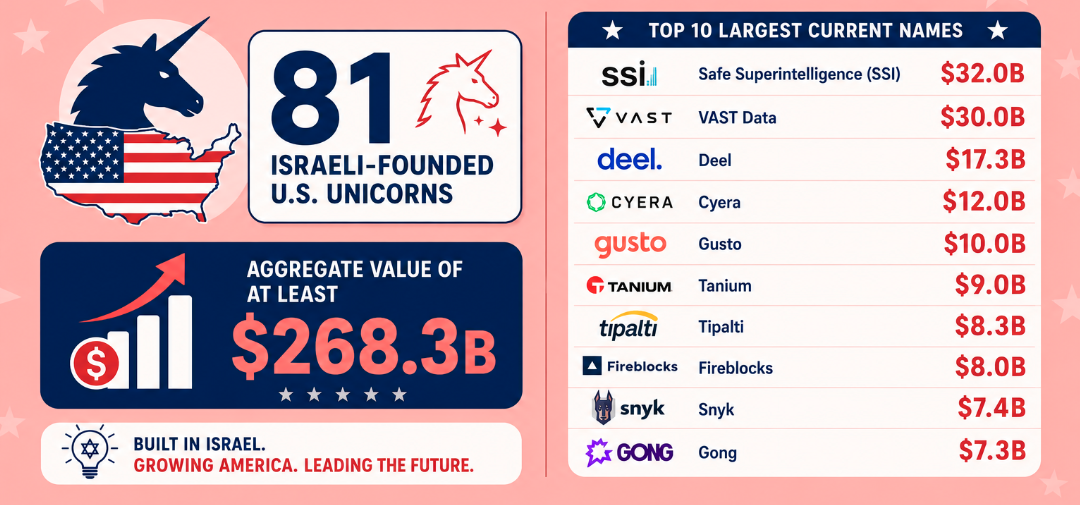
Today, 81 active U.S.-based unicorns founded by Israeli entrepreneurs are valued at more than $260 billion—creating jobs, paying taxes, driving innovation and strengthening the American economy.
|
Israel Invents - America Benefits |
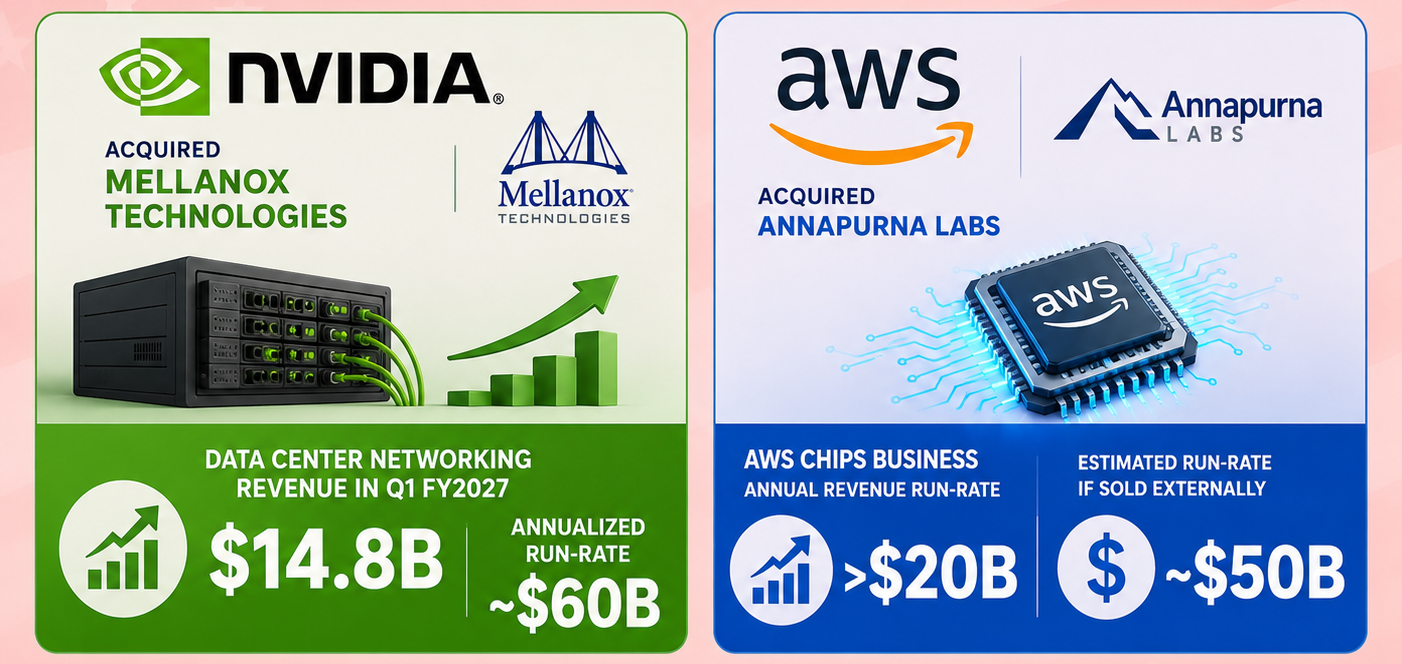
Israeli acquisitions now underpin major revenue engines for U.S. technology companies. NVIDIA’s Data Center networking business, which incorporates Israeli Mellanox technology, generated $14.8 billion in Q1 FY2027, equivalent to a $59.2 billion annualized run rate. Amazon’s Annapurna Labs develops Graviton, Trainium and Nitro semiconductors, whose revenue run rate has surpassed $20 billion. Amazon estimates that the business would represent roughly $50 billion annually if operated as a standalone chip supplier, and NVIDIA reports at least $1 trillion in demand visibility through 2027 for its Blackwell and Rubin platforms, whose scale depends heavily on high-speed networking.
|
Israeli Investments in America Continue to Build |
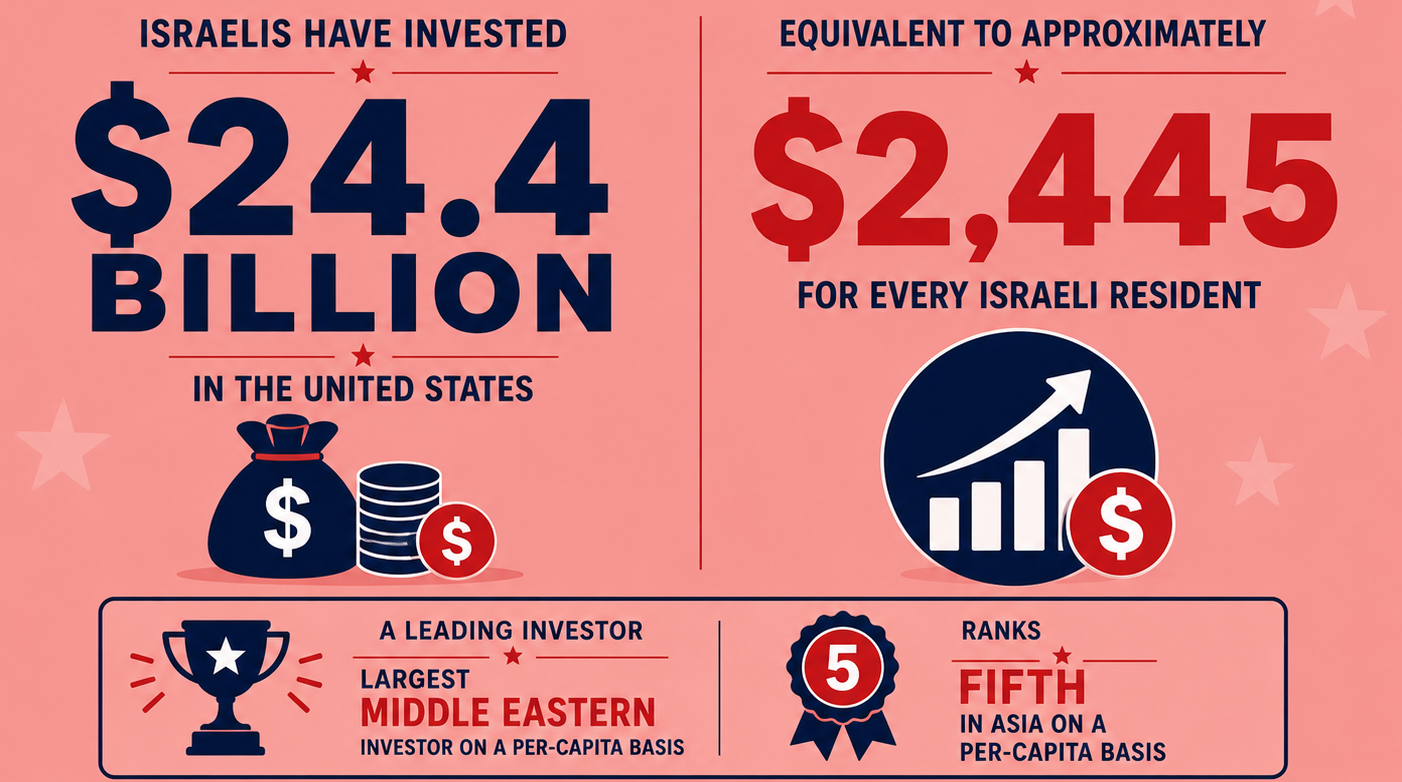
Israelis invested over $24 billion in the United States in 2024 — equivalent to approximately $2,445 for every Israeli. On a per-capita basis, Israel is the largest investor in the U.S. economy from the Middle East, and ranks fifth in all of Asia. This investment brings Israeli capital into American communities - supporting business growth, innovation, employment and commercial ties.
|
Updates on the Israeli Economy
|
|
|
|
|



.png)