🤖 New AI Strategy
💵 Forex Hits Record High
💪 Stronger Shekel
|
This week in Israel’s economy, the central development continues to be the strengthening of the local currency, the shekel, which
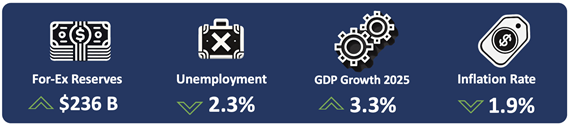
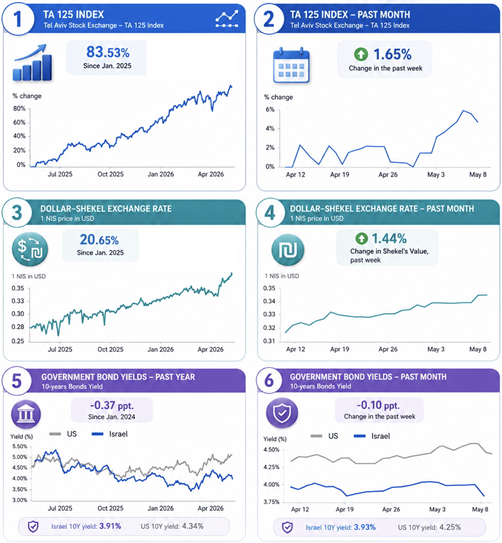
reached a value of $0.34 this week. Against the currency basket of Israel’s main trading partners, the shekel is now stronger than ever, following a 1.9% increase against the currency basket in the first quarter
of 2026. This appreciation sharpens the economic trade-off: on one hand, it supports lower inflation and eases the cost of living; on the other, it creates a growing challenge for Israeli exporters and the high-tech
sector, whose revenues are largely denominated in dollars while many of their expenses are in shekels. Against this backdrop, expectations for a possible interest rate cut at the Bank of Israel’s upcoming decision
are gaining momentum.
This week, the government approved a major defense procurement deal. The Ministry of Defense announced the approval of the acquisition of two new fighter jet squadrons: a fourth squadron of F-35 “Adir” aircraft manufactured by U.S. Lockheed Martin, and a second squadron of F-15IA aircraft manufactured by U.S. Boeing. The total value of the deals is estimated at tens of billions of shekels and includes
the integration of the squadrons into the Israeli Air Force, full support packages, spare parts, and logistics.
This marks the first step in implementing Israel’s force build-up plan for the coming decade, which was approved by the Prime Minister and the Minister of Defense and is backed by a dedicated budget of NIS 350
billion.
Israel is positioning itself as an AI powerhouse. The Israel Innovation Authority published a draft AI strategy for 2026, outlining government investment of approximately NIS 1 billion in infrastructure, research, data, human capital training, and enabling regulation. Against the backdrop of government activity in Israel, the country’s ranking in the Government Strategy component of the Tortoise Index rose from 47th place in 2023 to 14th place in 2025.
This week also saw the financial closing of Israel’s largest solar power plant, which will be built in Dimona (Southern Israel). The 265-megawatt project will provide electricity at a tariff of less than 6.5 agorot (2.2 cents) per kWh and will support electricity supply in southern Israel, including low-cost power for existing and future data centers expected to be built in the area by major American technology companies operating in Israel.
Following last week’s update, March macroeconomic data continues to come in, reflecting the impact of the war with Iran on Israel’s economy, . While the unemployment rate remained stable, there was a significant
increase in the number of people absent from work due to the war. This appears to be a temporary disruption, which is likely to be materially offset in the April data.
Average wages continued their upward trend, reaching NIS 14,344/month ($59,280 annualy) among Israeli workers, an increase of 5% year over year. Credit card purchases also grew with data for January through March 2026
showing a 1.3% increase during this period. In February, Israel’s services exports stood at $7.9 billion, seasonally adjusted, an increase of 9% compared with February 2025. Within total services exports,
business services exports rose by 11%, while high-tech services exports increased by 12.6%. Taken together, this week’s data points to an economy
still under pressure, but supported by strong momentum in wages, consumption, exports, technology, energy, defense investment, and a policy agenda focused on long-term competitiveness.
Stay informed and stand with Israel,
Noach Hacker
|
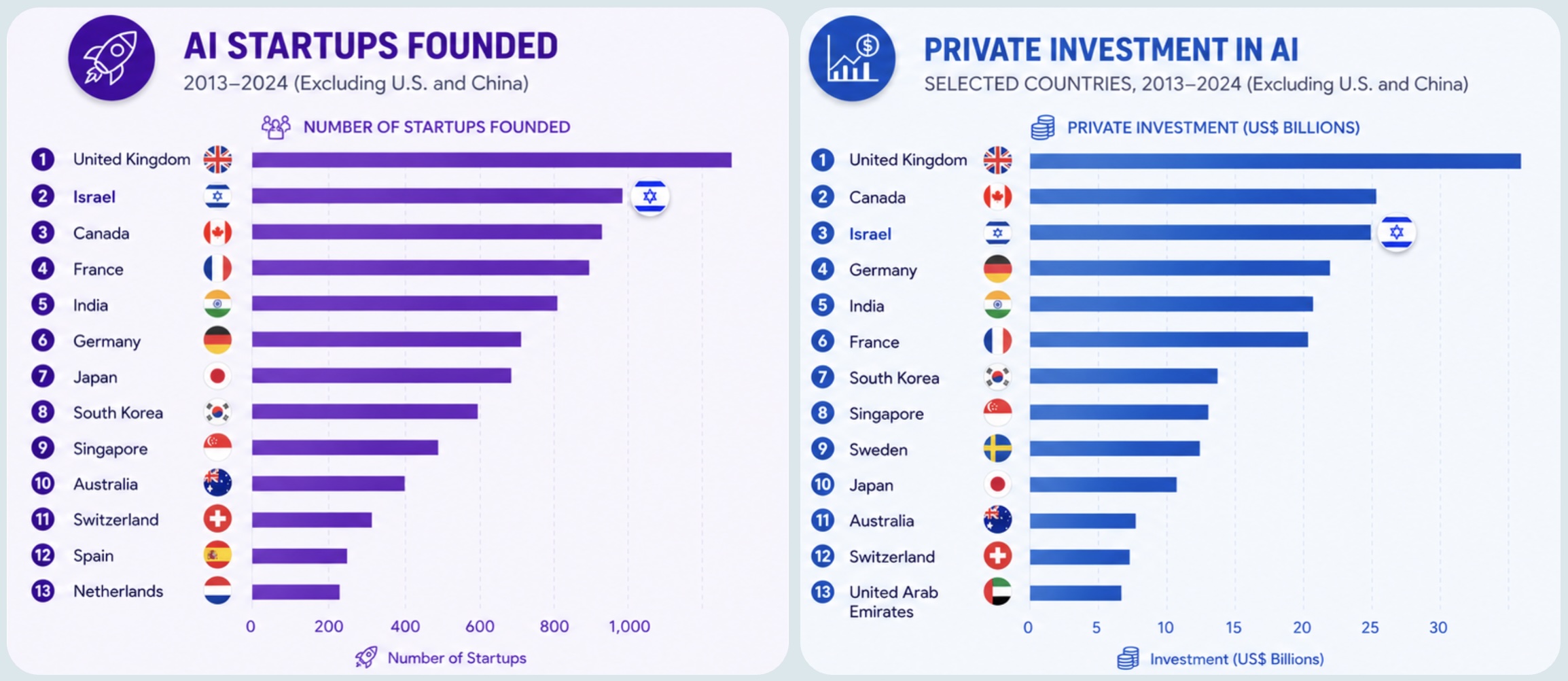
Israel’s AI strategy shows how the country can build a strong global position by focusing less on costly model training and more on high-value AI applications, infrastructure, technological breakthroughs, and geopolitical access. This focus builds on Israel’s
existing strengths: it ranks 4th globally in the number of AI startups founded and 5th in AI investment. The strategy sets clear goals, including the creation of AI-native unicorns, new AI chip-design startups, global research leadership,
and partnerships with the U.S. and other countries through frameworks such as Pax Silica.
|
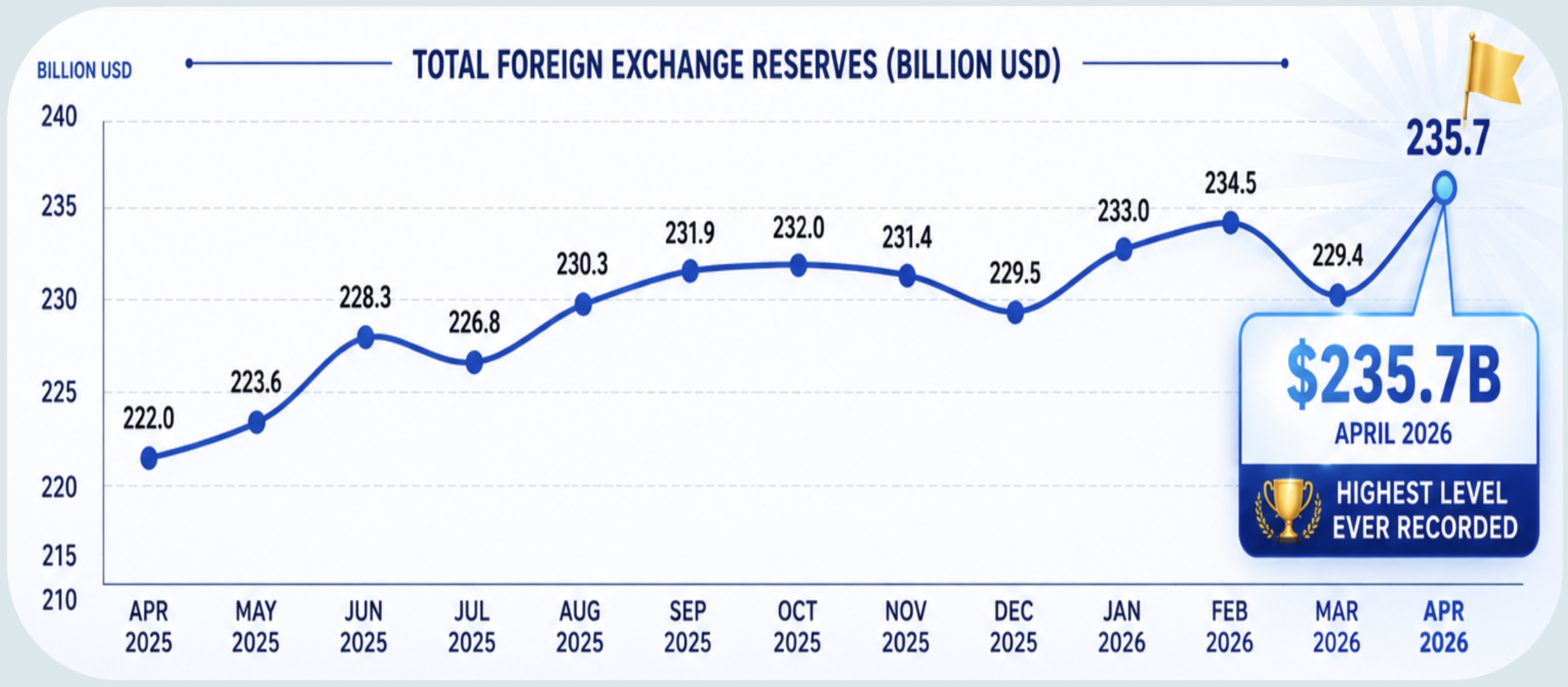
Israel’s foreign exchange reserves reached $235.7 billion at the end of April 2026, up $6.3 billion from the previous month, according to the Bank of Israel. The reserves stood at 38.4% of GDP, reflecting a large external buffer and strong financial resilience. The monthly increase was mainly driven by a $7.5 billion revaluation gain, partly offset by around $1.2 billion in government foreign-exchange activity.
|
Shekel Strongest than Ever
|
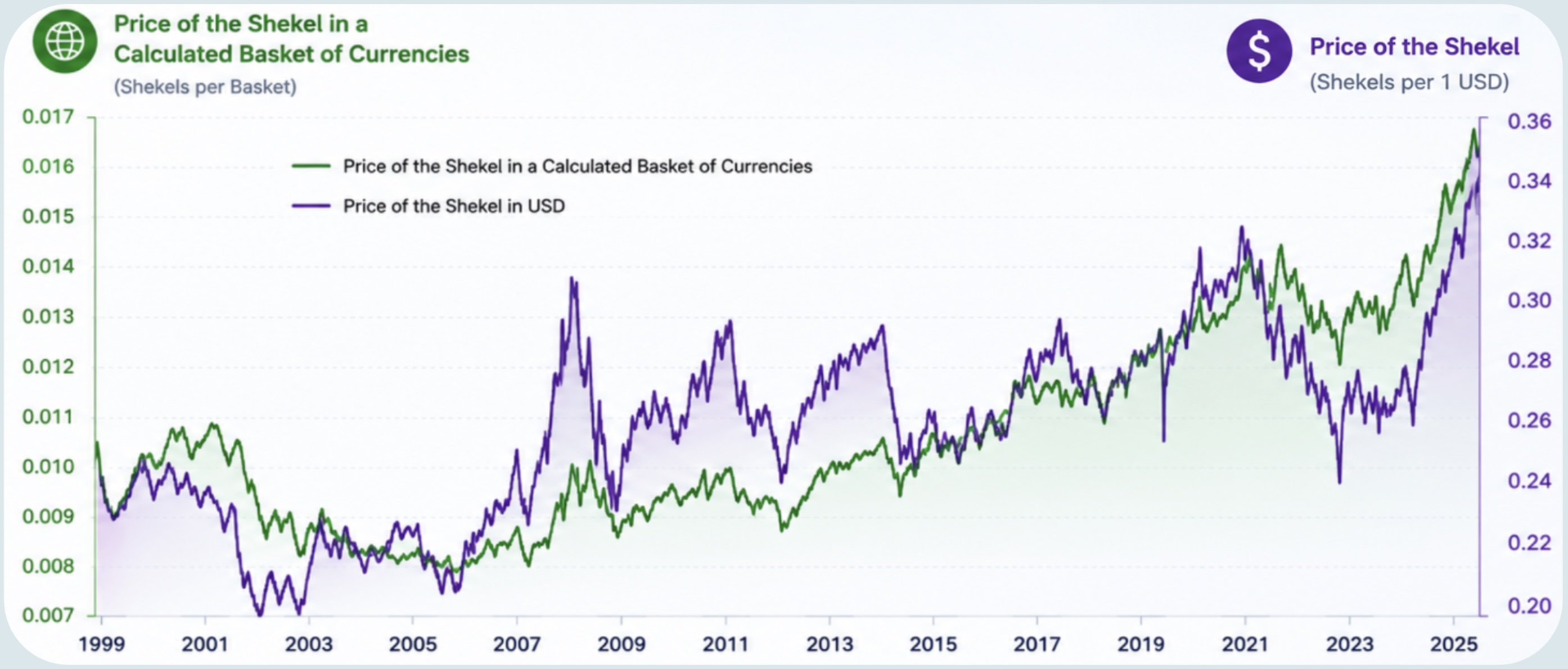
The shekel is trading at record strength on a broad, trade-weighted basis, according to the Bank of Israel’s Nominal Effective Exchange Rate Index. The index, which tracks the shekel against a basket of currencies, has fallen to around 60.7 in May 2026 - or an inverse of 0.0165, its highest level ever. this index is heavily affected by the appreciation of the Shekel against the US dollar, as the price of 1 shekel got to it's highest - 0.34$.
|
|
|
|
|





.png)